
Braces gradually move your teeth into better alignment to improve both your bite and your smile. Metal and ceramic (tooth-coloured) options are available across our five Hong Kong clinics — for teenagers and adults alike.
What braces do
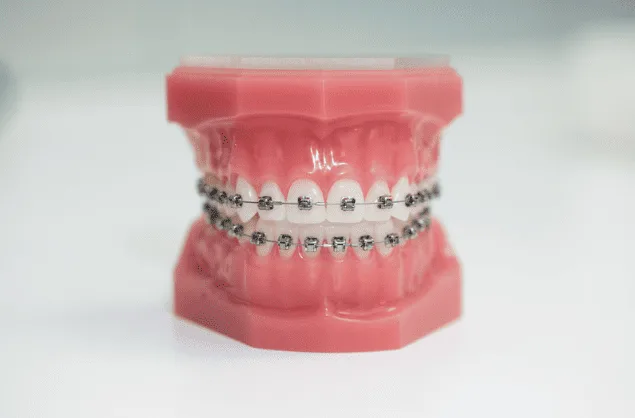
Braces use brackets bonded to the teeth and a thin archwire to apply gentle, steady pressure that guides teeth into a better position over time. As well as a straighter smile, orthodontics can improve how your teeth meet (your bite), which affects cleaning, chewing and long-term tooth wear. There is no upper age limit for braces, though bite problems are often clearest between about 8 and 12 years old, while the jaw is still developing.
Types of braces
- Metal braces: durable, effective and usually the most economical option.
- Ceramic braces (clear or “invisible” braces): tooth-coloured brackets that are far less noticeable than metal.
- Clear aligners: a removable alternative for suitable cases — see Invisalign & clear aligners.
The stages of treatment
- Consultation (about 30 minutes). The dentist examines your teeth and bite and discusses suitable options.
- Records. X-rays and scans or impressions are taken to plan the movement.
- Fitting (about one hour). The brackets are bonded and the first archwire placed — this is the longest single appointment.
- Adjustments. The wire is adjusted at regular reviews (see below) to keep the teeth moving.
- Retention. Once treatment finishes, a retainer holds the result — this step is essential to prevent relapse.
How long do braces take, and how often are visits?
This depends heavily on how much movement your case needs, so exact figures are confirmed only after an assessment. As a general guide:
- Treatment time: commonly at least 12–18 months, and longer for more complex bites.
- Adjustment visits: usually about every 4–6 weeks.
- After an adjustment: teeth may feel tender, typically for around 3–4 days depending on your tolerance.
Your dentist will give you a personalised estimate — these ranges are a guide only and vary from case to case.
Retainers
After the braces come off, a retainer keeps your teeth in their new position. Options include a fixed retainer (a fine wire bonded behind the front teeth), a removable Hawley retainer (wire and acrylic), and clear Essix/Vivera-style retainers. Wearing your retainer as directed is the single most important step to keep your result long-term.
How much do braces cost in Hong Kong?
Fees depend on the type of braces and the complexity of your case. As a reference, the Prince Philip Dental Hospital’s private-patient fee schedule lists fixed braces at HK$35,000–50,000 for a single arch and HK$45,000–70,000 for comprehensive treatment, and lingual braces at HK$100,000–200,000. These are reference fees only, not our clinics’ actual fees; your fee is confirmed after an assessment.
Fees above are reference fees from the Prince Philip Dental Hospital private-patient fee schedule, for reference only and not our clinics’ actual fees; your exact fee is confirmed after an examination. Please consult a dentist for advice on your situation.
Booking at your nearest clinic
Orthodontic consultations for braces are available across our five Hong Kong clinics. Our dentists speak English, Cantonese, Mandarin and other languages. Choose the location most convenient for you:
- Central — Smith & Jain, and Diestel & PartnersClinic websites: Smith & Jain braces · Diestel & Partners braces
- Tung Chung — Bayside DentalClinic website: Bayside Dental Tung Chung braces
- Discovery Bay — Bayside Dental (North Plaza & Main Plaza)Clinic website: Bayside Dental Discovery Bay braces
Frequently asked questions
How long does braces treatment take?
How often do I need adjustment visits?
Do braces hurt?
What is the difference between metal and ceramic braces?
Am I too old for braces?
Will I need to wear a retainer afterwards?
Braces or clear aligners — which is better for me?
Book an orthodontic consultation at your nearest Hong Kong clinic.